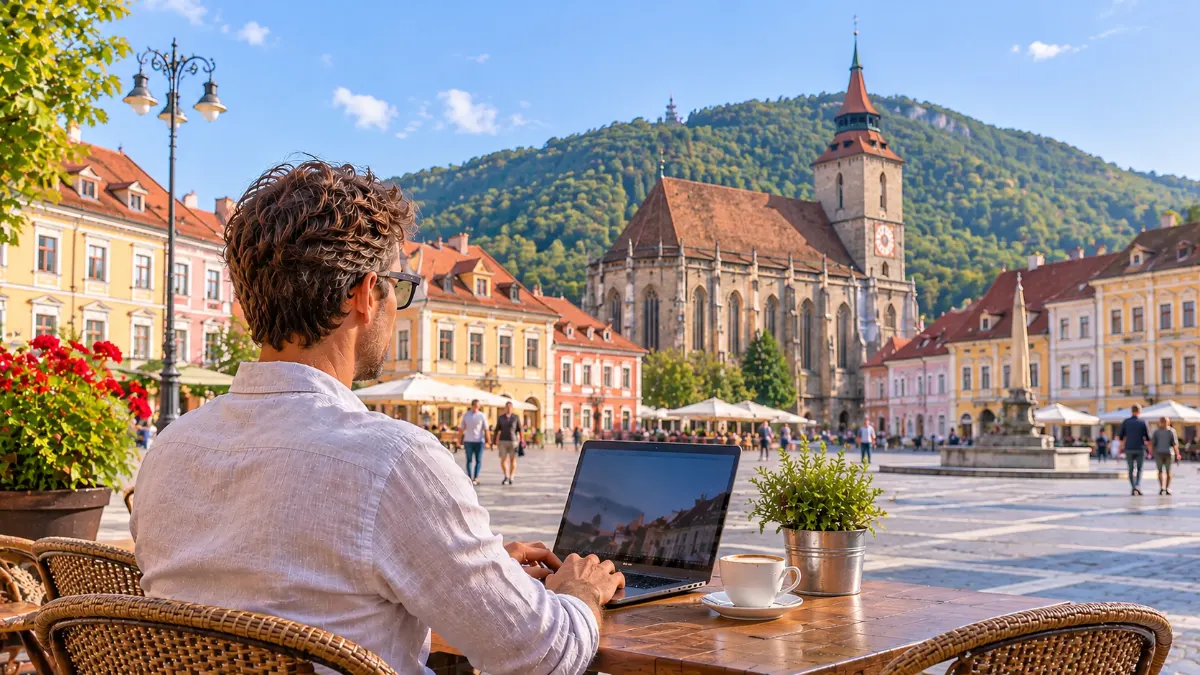
The Romania digital nomad visa gives non-EU remote workers a legal way to live in one of Europe’s cheapest and best-connected countries. Romania has some of the fastest home internet on the continent, it joined the Schengen area in full in January 2025, and a comfortable life in Bucharest or Cluj costs well under what you would pay in Lisbon or Barcelona.
The catch is the income requirement. It is set at three times the Romanian average gross salary, which puts it among the highest in Europe and far above what most older guides still quote. This guide gives you the 2026 picture: who qualifies, what you have to prove, how the tax exemption really works, and what life costs once you arrive.
Last checked against official and secondary sources in November 2026.
Take the WhereToNomad quiz to see how Romania ranks for your income, passport and priorities.
Romania Digital Nomad Visa at a Glance
| Detail | Value |
|---|---|
| Visa type | Long-stay visa for digital nomads (D/AS), followed by a residence permit |
| Income requirement | 3 times the average gross monthly salary, roughly 5,300 to 5,600 euros in 2026 |
| Proof period | Each of the last 6 months, and the whole stay |
| Visa fee | About 120 euros, plus residence permit fees |
| Duration | 90-day visa, then a renewable residence permit |
| Family | Separate family reunification application |
| Tax on foreign income | Exempt if you stay 183 days or fewer in any 12 months |
| Where to apply | Romanian consulate, starting on the eVisa portal |
See the full Romania country breakdown
Who Qualifies for the Romania Digital Nomad Visa
The Romania digital nomad visa was created in 2022 for citizens of countries outside the EU and EEA. You qualify through one of two routes, and they are not equally easy.
Route 1: Employee of a foreign company. You have an employment contract with a company registered outside Romania and you do your work remotely using information and communication technology. There is no minimum length of employment on this route.
Route 2: Owner of a foreign company. You own a company registered outside Romania and provide services through it. On this route you must show that you have been doing this remotely for at least three years. In practice this rules out anyone who became self-employed recently.
If you are a freelancer without a registered company, or your company is less than three years old, the Romania digital nomad visa is hard to obtain. Programs with lighter rules for freelancers are covered in our best digital nomad visa in Europe guide.
Romania Digital Nomad Visa Income Requirement
The law sets the bar at three times the average gross monthly salary in Romania. That average is published officially and rises most years, so the threshold is a moving target. In 2026 it works out to roughly 27,000 lei per month, which is about 5,300 to 5,600 euros.
Two details make it stricter than it sounds:
- You must meet the figure in each of the six months before you apply. One weak month can sink the application, even if your average is above the line.
- You must also show that the income will continue for the whole period of the visa.
Many guides still quote 3,300 to 3,700 euros. Those figures come from earlier years. Always check the current average salary and multiply by three before you rely on a number. Our digital nomad visa income requirements ranking shows how Romania compares with every other program.
Documents for the Romania Digital Nomad Visa
- Passport valid for the whole stay
- Employment contract with the foreign company, or company registration documents and proof of three years of remote activity
- Proof of income for each of the last six months
- A letter of intent explaining your plans in Romania
- Proof of accommodation in Romania
- Health insurance valid in Romania for the visa period, commonly with coverage of at least 30,000 euros
- Criminal record certificate from your country of residence
- Tax certificate from your home country confirming that your taxes and contributions are paid up to date and that you have no record of tax evasion
The tax certificate is the document people underestimate. It must be an original from the competent authority, with an apostille or legalization, and an authenticated Romanian translation. Start it early, because it often takes the longest. Compare cover that meets consular rules in our expat health insurance guide.
How to Apply for the Romania Digital Nomad Visa
- Check the current income threshold and confirm which route you qualify under.
- Order the tax certificate and criminal record certificate, then have them apostilled and translated.
- Register your application on the Ministry of Foreign Affairs eVisa portal and upload your documents.
- Attend an appointment at the Romanian embassy or consulate that covers your country of residence, and pay the visa fee.
- Wait for the long-stay visa. It is granted for 90 days.
- Travel to Romania and apply for your residence permit at the General Inspectorate for Immigration before the visa expires.
Romania digital nomad visa applications are handled in person at consulates, and processing commonly takes one to three months, so start well ahead. See our how to apply for a digital nomad visa guide for the general steps and why digital nomad visas get rejected for the mistakes to avoid.
Residence Permit and Renewals
The long-stay Romania digital nomad visa only gets you into the country. The residence permit is what lets you stay. It is issued for a limited period and can be renewed while you continue to meet the conditions. Each renewal means proving your income again, and company owners must keep showing their three-year remote work history.
Romania does have a general route from temporary residence to long-term residence after five continuous years. Whether time as a digital nomad counts is not clearly confirmed, so do not plan your future around it. For programs built to lead to residency, read our Portugal D8 guide and Spain digital nomad visa guide.
Bringing Your Family on the Romania Digital Nomad Visa
Family members are not added to your visa automatically. A spouse and children apply through Romania’s family reunification route with their own documents and proof of means of support. Allow extra time for this. Our digital nomad visa for families guide lists the countries where family applications are simpler.
Taxes on the Romania Digital Nomad Visa
Law No. 69/2023 was passed to make the Romania digital nomad visa more attractive. It exempts qualifying digital nomads from Romanian income tax and social contributions on their foreign salary or business income.
The condition is the important part. The exemption is tied to spending no more than 183 days in Romania in any period of 12 consecutive months. Stay longer and you can become a Romanian tax resident, taxed on worldwide income. Romania’s personal income tax is a flat 10%, which is low by European standards, and social contributions can apply on top.
So there are two ways to use the Romania digital nomad visa:
- As a part-year base. Spend up to 183 days in Romania, the rest elsewhere, and keep the exemption.
- As a full-time home. Stay all year, accept Romanian tax residency, and plan for the 10% rate with a local accountant.
Either can make sense. Deciding by accident is what causes problems. Read our 183-day rule explainer and compare systems in digital nomad taxes by country. US citizens should also see digital nomad taxes for Americans.
Cost of Living in Romania
This is where the Romania digital nomad visa pays you back. Our country data shows an average one-bedroom rent of about $525 in city centers and $410 outside them, with average internet speeds around 185 Mbps. Gigabit fiber at home is common and cheap.
| Expense | Bucharest | Cluj-Napoca | Brasov |
|---|---|---|---|
| 1BR apartment | $550-900 | $500-800 | $400-650 |
| Coworking space | $120-200 | $110-180 | $90-150 |
| Groceries | $200-300 | $200-300 | $180-270 |
| Dining out | $180-320 | $170-300 | $150-260 |
| Transport | $20-40 | $20-40 | $15-30 |
| Health insurance | $50-100 | $50-100 | $50-100 |
| Total | $1,300-2,000 | $1,200-1,900 | $1,000-1,600 |
Bucharest is the biggest and most international city, with the best flight connections and the widest choice of coworking spaces. Our digital nomad guide to Bucharest covers neighborhoods and workspaces in detail. Cluj-Napoca is the tech capital of Transylvania, younger and more compact. Brasov is a mountain town with a medieval center, popular with people who want hiking and skiing nearby. Timisoara and Sibiu are quieter alternatives.
Romania uses the leu, not the euro, so a multi-currency account saves money on rent and daily spending. See our best bank accounts for digital nomads guide.
Browse Bucharest apartments on Booking for your first weeks, and set up an Airalo eSIM for Romania before you arrive.
Pros and Cons of the Romania Digital Nomad Visa
Pros
- Tax exemption on foreign income for stays of 183 days or fewer in 12 months
- Flat 10% income tax if you do become resident
- Full Schengen membership since January 2025
- Very fast, very cheap internet
- Low cost of living with a good quality of life
- No minimum length of employment for remote employees
Cons
- One of the highest income bars in Europe, and it rises every year
- Income must be met in every one of the last six months
- Company owners need three years of remote activity
- Heavy paperwork, including an apostilled tax certificate
- In-person consulate process and slow processing
- Family members need a separate application
Romania Digital Nomad Visa vs Other European Options
| Feature | Romania | Hungary | Croatia | Bulgaria |
|---|---|---|---|---|
| Income bar | About 5,300 to 5,600 euros | 3,000 euros net | About $3,930 | About $2,800 |
| Freelancers | 3 years of history needed | Possible | Possible | Possible |
| Tax if resident | Flat 10% | Flat 15% | See guide | Flat 10% |
| Family | Separate route | Not allowed | Allowed | Allowed |
If you earn enough and work for a foreign employer, the Romania digital nomad visa offers a strong mix of low costs, low tax and Schengen access. If you earn less or freelance, Bulgaria and Hungary are easier to qualify for. Many remote workers skip the visa entirely and spend up to 90 days in Romania as visitors, which our digital nomad visa vs tourist visa guide explains.
Frequently Asked Questions
What is the income requirement for the Romania digital nomad visa?
You must earn at least three times the Romanian average gross monthly salary, in each of the six months before you apply. In 2026 that is roughly 5,300 to 5,600 euros per month.
Can freelancers get the Romania digital nomad visa?
Only if they own a company registered outside Romania and can show at least three years of providing services remotely through it. Remote employees of foreign companies have no such requirement.
Do I pay tax on the Romania digital nomad visa?
Qualifying digital nomads are exempt from Romanian income tax on foreign income if they spend no more than 183 days in Romania in any 12 consecutive months. Longer stays can create tax residency, with a flat 10% income tax.
Is Romania in the Schengen area?
Yes. Romania became a full Schengen member on January 1, 2025, so residence there allows short stays elsewhere in the Schengen area.
Can I bring my family on the Romania digital nomad visa?
Not on the same application. Family members apply through the family reunification route with their own documents.
Also read: Best Digital Nomad Visa in Europe | Digital Nomad Guide to Bucharest | Cheapest Countries to Live In | Digital Nomad Visa Income Requirements
Find your perfect digital nomad visa match
Answer 5 questions — personalized results in under 2 minutes. Free.
Take the Free Quiz →