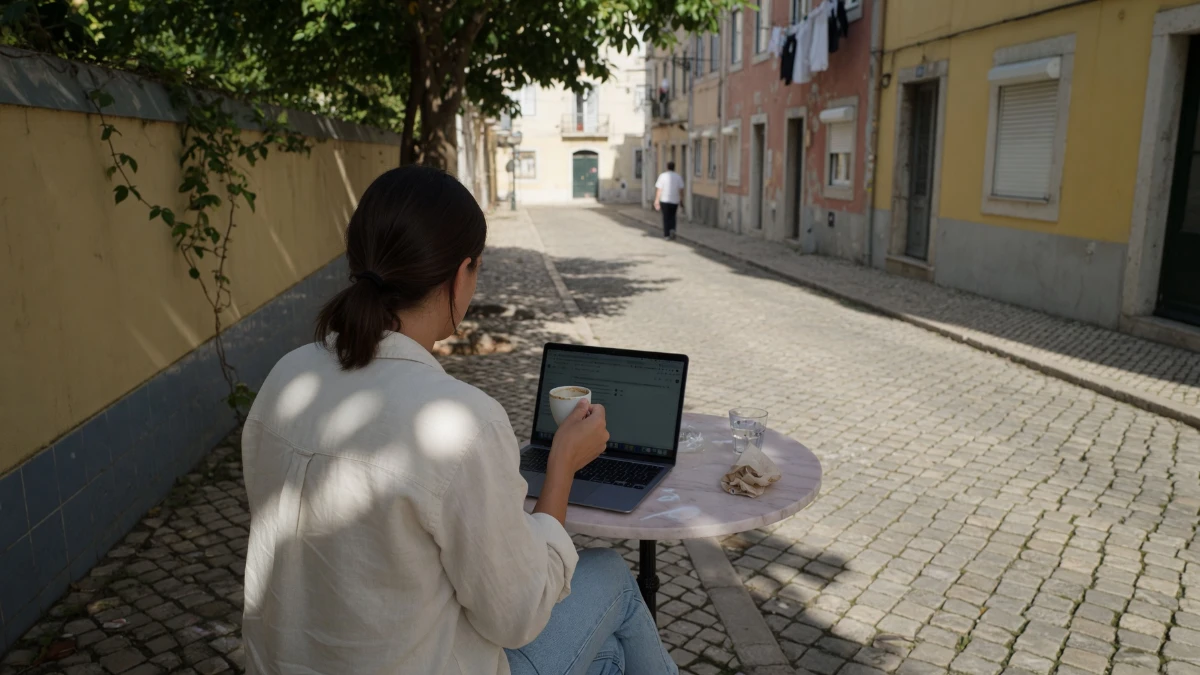
The digital nomad community has been overwhelmingly framed through one demographic profile, and it is not solo women. Most nomad blogs are written by men and assume male-default experiences: walking home alone at 1am, traveling to remote rural areas solo, taking the cheapest hostel option without thinking about it, drinking with strangers because there are always more friends being made. None of this is wrong for the people it applies to, but it leaves an enormous gap in the practical information available to solo women considering the lifestyle.
This guide closes that gap. It covers what solo female digital nomads actually need to know in 2026: the safest countries (with real data, not “vibes”), the cities with the strongest female nomad communities, the safety practices that experienced nomadic women actually use, and the questions and realities that almost no other source addresses honestly.
Not sure where to start? Take the free WhereToNomad quiz to find visa countries that match your income and lifestyle, then come back here to filter for solo female considerations.
What “Safe” Actually Means as a Solo Female Nomad
Most “safest countries” lists rank by general crime statistics: homicides, violent crime, theft. These numbers matter, but they’re not the lens a solo female nomad actually uses to choose a destination. The lived experience that matters is more specific:
- Can I walk home alone after dark without active threat?
- Can I take a taxi alone without harassment or fear?
- Can I work from a cafe without being approached repeatedly by men who won’t take “no” for an answer?
- Can I stay in an apartment with confidence in its security?
- Can I rent a motorbike or car and drive without intimidation?
- If something does happen, will the police and the healthcare system take me seriously?
These are different from general crime rates. A country with low homicide rates but high street-harassment culture is “safe” in the conventional sense but exhausting to live in solo. A country with higher overall crime but strong female-friendly social norms and reliable public transit can feel safer in daily life.
The country picks in this guide use the second lens. Some surprises: Mexico City is genuinely safer for solo female nomads in 2026 than its reputation suggests, particularly in nomad neighborhoods. Bali is more complicated than its “easy” reputation. Eastern Europe is consistently underrated.
The Top 10 Countries for Solo Female Digital Nomads in 2026
| Rank | Country | Best City | Why It Ranks |
|---|---|---|---|
| 1 | Portugal | Lisbon | Low harassment culture, mature solo-female community, EU safety standards |
| 2 | Japan | Tokyo, Osaka | World’s safest country, near-zero street harassment, female-only train cars |
| 3 | Spain | Madrid, Valencia | Strong female safety norms, dense walkability, late-night culture safe |
| 4 | South Korea | Seoul | Very low crime, strong cafe culture, fast public transit |
| 5 | Taiwan | Taipei | One of Asia’s safest, English-friendly, strong solo travel infrastructure |
| 6 | Croatia | Split, Zagreb | Underrated EU pick, low crime, tight nomad community |
| 7 | Estonia | Tallinn | Free Remotely from Georgia equivalent, digital-first society, low crime |
| 8 | Georgia | Tbilisi | Surprisingly female-friendly capital, free visa, low cost |
| 9 | Mexico | Mexico City (specific neighborhoods) | Roma Norte / Condesa solo-female-strong; Latin America’s largest community |
| 10 | Thailand | Chiang Mai | Bangkok possible but Chiang Mai stronger for solo women due to community |
1. Portugal (Lisbon)
Portugal has the strongest combination of safety, community, and accessibility for solo female nomads in Europe. Lisbon specifically has built an unusually mature solo-female nomad ecosystem over the past decade. Women’s coworking events, female-only retreat weeks, and a culture of women hosting other women in shared apartments have made Lisbon something close to a default first nomad destination for solo women.
The honest assessment: Late-night walking in central Lisbon is genuinely safe, particularly in Principe Real, Estrela, and Marvila. Public transit is reliable and used by solo women at all hours. Catcalling exists but is rare and rarely escalates. Healthcare for women’s reproductive needs is accessible.
Visa: Portugal D8 (EUR 3,480/month income required) Solo female community: Lisbon Girl Gone International, Lisbon Female Founders, Selina Lisbon’s women’s events
Browse Lisbon accommodation on Booking.com: start with verified hotels for the first week, then transition to monthly rentals via Idealista. Portugal eSIM via Airalo for instant connectivity on arrival.
2. Japan (Tokyo, Osaka)
Japan is statistically one of the safest countries in the world, with violent crime rates among the lowest of any developed country. For solo female nomads, the daily experience is correspondingly remarkable: walking alone at 1am in Tokyo is genuinely safer than walking alone at noon in most other developed-country capitals.
The honest assessment: Street harassment is rare; the cultural norm is non-engagement with strangers, which works in favor of women who simply want to be left alone. Public transit has female-only train cars during rush hours on many lines. The language barrier is real outside major cities, but the social safety net is exceptional. Healthcare is excellent and professionally non-judgmental for women’s needs.
Visa: Japan Digital Nomad Visa (~$66,000/year, 6-month maximum, 49 eligible countries) Best cities for solo women: Tokyo, Osaka, Kyoto, Fukuoka
Japan eSIM via Airalo is essential since physical SIM cards in Japan typically require residence registration.
3. Spain (Madrid, Valencia)
Spain combines the EU safety standard with a Mediterranean street culture that’s surprisingly female-friendly. The late-night dining culture (Spaniards eat dinner at 10pm, drinks afterward) means streets are populated with families and groups at hours that would feel empty in northern Europe.
The honest assessment: Major Spanish cities are walkable, transit-rich, and have low rates of violent crime. Cultural norms include direct verbal pushback against unwanted attention in public, which has reduced street harassment over the past decade. Valencia specifically has become a strong pick for solo women due to lower cost than Barcelona/Madrid and a tight expat community.
Visa: Spain Digital Nomad Visa (EUR 2,762/month) plus the powerful Beckham Law tax regime Solo female community: Madrid Girl Gone International, Valencia Nomad Girls, Barcelona Women Who Travel
4. South Korea (Seoul)
Seoul has emerged as one of Asia’s safest cities for solo female nomads. Crime rates are very low, public transit is exceptional and runs late, and the cafe culture supports working alone without unwanted attention. The drawback: South Korea’s cultural norms around drinking and nightlife can include unwanted situations in some contexts, so calibrate accordingly.
Visa: South Korea F-1-D Workation (~$66,000/year)
5. Taiwan (Taipei)
Taipei is genuinely one of the world’s most underrated cities for solo female travel. Crime rates rival Japan’s, English is more widely spoken than in Japan or Korea, the public transit system is exceptional, and the food and cafe culture is dense and accessible. Solo dining is normalized, and the social atmosphere is non-intrusive.
Visa: Taiwan Gold Card (skilled professionals) or visa-free entry for short stays
6. Croatia (Split, Zagreb)
Croatia has built a quiet reputation as one of Europe’s safer underrated picks. The EU/Schengen safety standards apply, but with a smaller-city scale that makes life more manageable for solo nomads. Split has a particularly tight solo-female community during the May-October season.
Visa: Croatia Digital Nomad Permit (tax-free for foreign income)
7. Estonia (Tallinn)
Estonia is the world’s most digital-first society, with low crime, fast internet, and an established remote work culture. Tallinn’s Old Town and the Kalamaja district are popular nomad areas. The cold winters are real, but the city’s safety reputation is consistent year-round.
Visa: Estonia Digital Nomad Visa
8. Georgia (Tbilisi)
Tbilisi delivers extraordinary value: zero application fee, no income requirement (Remotely from Georgia program), territorial tax (zero local tax on foreign income), low cost of living. Surprisingly female-friendly for the region, with a growing solo-female community and a wine culture that supports daytime social life rather than late-night drinking dependency.
The honest assessment: Georgian culture is hospitable and generally non-intrusive toward foreigners. Some street harassment exists but is mild compared to Mediterranean averages. The drawback: limited gynecological healthcare options outside Tbilisi.
Visa: Georgia Remotely from Georgia (free, no income required)
9. Mexico (Mexico City, specific neighborhoods only)
Mexico City is the most complicated pick on this list. The general reputation suggests danger, but the lived experience in Roma Norte and Condesa: the dominant nomad neighborhoods: is genuinely safe for solo women. These neighborhoods have walkable infrastructure, low rates of violent crime against tourists, strong community presence, and 24-hour life that means streets are never empty.
The honest assessment: Mexico City’s overall crime statistics include neighborhoods that solo nomads have no reason to enter. Restrict your routine to Roma Norte, Condesa, Polanco, Juarez, and Coyoacan. Use Uber rather than street taxis. Don’t walk alone at 3am even in good areas. The community is exceptionally welcoming and the cost-of-living to lifestyle ratio is hard to beat in the Americas.
Visa: Mexico Temporary Resident Visa (~$4,300/month income) Solo female community: Mexico City Women in Tech, Roma Norte solo-female WhatsApp groups, Tara/Selina events
Mexico eSIM via Airalo covers Telcel reliably.
10. Thailand (Chiang Mai over Bangkok)
Thailand is generally safe for solo female nomads, but Chiang Mai outperforms Bangkok specifically for this audience. The reasons: smaller scale (everything is bikeable or walkable), Nimman’s coworking culture is exceptionally welcoming to solo women, the long-established expat community includes hundreds of nomadic women, and the “Songtaew red truck” transit option avoids the late-night taxi negotiation that some women find tiring in Bangkok.
Bangkok is fine, but the solo-female experience is more cosmopolitan and less embedded in a tight community. For first-time solo female nomads in Asia, Chiang Mai is usually the stronger pick.
Visa: Thailand DTV (THB 500,000 savings ≈ $15,000)
Where to Be More Cautious (or Avoid Entirely)
Some popular nomad destinations have real challenges for solo female travelers in 2026. Not “don’t go” advice: many women have great experiences in these places. But honest information matters.
Bali (Indonesia). Bali is fine for many solo female nomads in established areas (Canggu, Ubud), but the late-night party culture and the dense male expat population in Canggu specifically creates more unwanted attention than most Asian alternatives. The motorbike culture also creates real safety risks. If Bali calls to you, lean toward Ubud (yoga/wellness scene) over Canggu (surf/party scene).
Egypt, Morocco, and most of North Africa. Generally significantly more difficult for solo female nomads due to cultural norms around women in public. Many women have rewarding experiences but the daily energy investment in managing unwanted attention is high.
Most of India. Street harassment culture is well-documented. Some specific areas (Goa, Pondicherry) and certain expat-heavy neighborhoods of Bangalore/Mumbai are more manageable, but India is generally a more demanding choice for solo female nomads than the destinations on the main list above.
Colombia (Medellin): with caveats. Medellin’s nomad community is large and diverse, and many solo women have great experiences there. But the rate of incidents involving drugged drinks, app-based dating predators, and theft is meaningfully higher than in comparable cities. Stay in El Poblado or Laureles, use only trusted ride-sharing apps, never accept drinks from strangers in bars.
Eastern South America (Brazil, Argentina): varies by city. Buenos Aires is generally safe in Palermo; Rio de Janeiro is more variable. Both reward solo female nomads who research neighborhood-specific dynamics rather than country-level generalizations.
Practical Safety Practices Solo Female Nomads Actually Use
These are the practical habits that experienced solo nomadic women report using daily. None are revolutionary; the cumulative effect is significant.
1. Always carry a doorstop. $5 wedge doorstop from any hardware store. Goes under your hotel/Airbnb door at night. Will not stop a determined intruder, but will buy you 10-15 seconds and significant noise warning. Multiple women have reported this saving them from genuinely dangerous situations.
2. Use only one type of ride-sharing app per country, learned in advance. Uber in most of Latin America and Mexico. Grab in Southeast Asia. Bolt in Europe. Don’t take street taxis or accept rides from anyone not visible in the app. The few seconds saved is never worth it.
3. Photograph the license plate before getting in any ride-share. Quietly, before opening the door. Send it to one trusted contact via WhatsApp or iMessage. Most experienced nomadic women do this reflexively.
4. Maintain one trusted check-in person. Someone (parent, sibling, friend) who knows where you are this week and gets a “still alive” message daily. The check-in person doesn’t need to do anything; they just need to be a known person who would notice if you disappeared. This is not paranoid: it’s the single most effective safety net available.
5. Pre-load offline maps. Google Maps offline downloads for your full city before arriving, plus city alternatives (Maps.me, OsmAnd). Phone batteries die. Networks fail. Knowing how to navigate without internet matters in unfamiliar places.
6. Keep at least $300 in cash and a backup card stored separately from your wallet. If a wallet gets stolen or lost, you need immediate purchasing power until you can replace cards. Keep these in a different bag than your daily wallet.
7. Carry a copy of your passport (digital and printed), separate from the physical passport. Email yourself the passport scan. Keep a printed copy in your luggage. Some countries require a passport ID for many activities and the original gets stolen or stays in a safe.
8. Establish a “first home base” before you arrive. Don’t land in a new country planning to find accommodation that day. Pre-book at least the first 3-5 nights, ideally in a known nomad-friendly neighborhood (Booking.com for flexibility). Tired, jet-lagged decision-making is when most security mistakes happen.
9. Use a VPN on every device. NordVPN or similar. Critical for banking access on foreign WiFi, also for accessing your home-country streaming and communication services. See our best VPN guide for alternatives.
10. Carry comprehensive medical insurance. Required by virtually every digital nomad visa, also critical for any solo traveler. A global plan via VisitorsCoverage covers most nomad scenarios. See our travel insurance comparison for detailed plan analysis.
Finding Community Specifically as a Solo Female Nomad
Solo doesn’t mean alone. The strongest solo female nomads we’ve encountered all maintain active community ties through one or more of these channels:
Girls in Marketing, Girl Gone International, Bumble BFF. International women’s networks with chapters in most major nomad cities. Bumble BFF specifically has become a default tool for solo female nomads to meet other women locally.
Coworking spaces with active women’s programming. Selina coworking spaces, WeWork’s Women’s Networks, Outpost (Bali), and Spaces all host regular women-focused events. Selina specifically operates “Women in Selina” programming in most major locations.
Women-only retreat weeks. Companies like Hacker Paradise, WiFi Tribe, and Remote Year all operate occasional women-only cohorts. These are intensive 1-month experiences with built-in community.
Local women’s social clubs. Lisbon, Mexico City, Bali, and Chiang Mai all have women-only or women-led social clubs that long-term nomads find. Ask in the local nomad-women Facebook groups.
The “second-time-in-city” effect. First trip to any city, you’ll spend most of your time alone or with weak ties. Second trip to the same city 6 months later, you have a network. This is why slow rotation (3-6 cities per year, returning to favorites) often produces stronger community than fast travel.
Special Considerations: Healthcare, Reproductive Rights, and Tampons
Three areas where solo female nomads need specific information that male-default nomad content typically skips entirely.
Birth control access. Varies enormously. In Portugal, Spain, and Germany, birth control is widely accessible and often subsidized. In Mexico, pharmacies sell most types over the counter. In Japan, oral contraceptives require prescription and not all options are available. In some Middle Eastern and conservative countries, access is significantly restricted. Carry a 6-month supply across all transitions.
Abortion access. Legal access varies dramatically by country. Within Europe, Spain, Germany, the UK, France, and the Netherlands have liberal access. Portugal has access with a 10-week limit and a 3-day reflection period. Within Asia, Japan and Singapore have access; Thailand and the Philippines have significant restrictions. Within Latin America, Mexico City legalized abortion in 2007, Argentina nationwide in 2020, Colombia in 2022 (with limits). If reproductive autonomy matters to your country selection, research current legal status before committing to a long-term stay.
Menstrual products. Quality varies widely. Tampons are widely available in Europe and the Americas but less so in many Asian countries, where pads dominate. If you use tampons or a menstrual cup, plan to carry your preferred products. Asian pharmacies typically stock pads but not tampons; brands like OB and Tampax are not universally available.
Gynecological care. English-speaking gynecologists are easy to find in Portugal, Spain, Mexico City, Thailand (Bangkok, Chiang Mai), and most major European cities. More difficult in smaller cities and some Asian destinations. Major nomad hubs all have at least one international clinic with English-speaking women’s health providers.
The Dating and Romance Reality
Most nomad guides skip this. It matters.
Solo female nomads typically find that dating dynamics shift in three predictable ways:
1. Apps work differently in nomad cities. Tinder, Hinge, and Bumble in Lisbon, Mexico City, Bali, and Chiang Mai are saturated with other nomads (often other women) plus a layer of locals specifically targeting nomadic women. The “dating economy” is denser but the durability of connections is typically shorter. Many women find the apps frustrating in these contexts and shift to community-based meeting.
2. Local men are not all “predatory”: but a small percentage in nomad-heavy cities actively target nomadic women. This requires no panic but does require pattern recognition. The classic signs include unusually fast emotional intensity, immediate requests for money or financial help, urgency around meeting in private locations, and inability to introduce you to their own friends or family.
3. Long-distance relationships and nomad-couple dynamics are real but require structure. Couples who try to “wing it” with no shared calendar or shared decision-making typically end faster than couples who treat the nomadic lifestyle as something requiring deliberate coordination. Solo female nomads who want to maintain or build serious relationships typically benefit from establishing a “primary city” they return to 2-4 times per year.
Solo Female Nomad Budget Realities
A note on cost: as a general pattern, solo female nomads tend to spend 10-20% more per month than solo male nomads in the same city. The differential is not preference; it’s safety and practicality. Examples:
- Ride-sharing instead of public transit at night. $5-15/night × 3-4 nights/week = $60-240/month extra
- Higher-end accommodation in safer neighborhoods. Often $200-500/month premium over the cheapest available options
- Tampons/menstrual products at premium prices in countries that don’t stock them well. Variable but real
- Solo dining at slightly nicer restaurants (because dining alone at a divey local spot is more uncomfortable for many women than for many men). Adds up to $100-200/month
- Hairdressing, skincare, women’s healthcare that costs more in many countries than the equivalent male services
This is not a complaint; it’s planning. Solo female nomads typically need a 10-20% larger budget than the standard “single nomad” cost-of-living estimates published in male-default nomad content.
For broader cost analysis, see our best cities for digital nomads guide and cheapest digital nomad visas.
The First Trip: A Recommended Starter Path
If you’re a solo female considering nomad life and don’t yet have a strong location preference, here’s the path that works for most people:
Month 1-2: Lisbon. Easiest possible solo female nomad onboarding. Established community, EU safety, English widely spoken, gradient of accommodation options. Use Lisbon to confirm whether you actually like nomad life at all.
Month 3-4: Madeira or Porto. Stay in Portugal but shift to a smaller city. Test how you handle smaller communities and less infrastructure.
Month 5-6: A second-region pick. Mexico City (if you want Americas time zone) or Chiang Mai (if you want lower cost and Asian experience). This is your first major time-zone change and language shift.
Month 7-12: Specialize. By month 7, you’ll know which dimensions matter most to you. From here, customize.
This path builds confidence gradually rather than dropping a first-time solo female nomad into the most challenging environment possible. Most women who fail at nomad life fail in the first 60 days due to overwhelming logistics, isolation, or safety stress. The path above minimizes all three.
For broader getting-started guidance, see our how to become a digital nomad guide.
Find Your Best Match
Solo female digital nomad life in 2026 is more accessible than ever, with established communities and proven safety practices across dozens of countries. The right destination depends on your income, passport, lifestyle priorities, and the specific safety considerations covered in this guide. Take the free WhereToNomad quiz to see your personalized ranked list of every visa you qualify for, with safety, cost, and community considerations.
Also read: Best Cities for Digital Nomads | How to Become a Digital Nomad | Best Digital Nomad Visa in Europe | Best Digital Nomad Visa in Asia | Best Digital Nomad Visa in Latin America | Digital Nomad Burnout | Best Travel Insurance | Digital Nomad Toolkit | Best VPN | Best eSIM | Digital Nomad Visa for Families
Find your perfect digital nomad visa match
Answer 5 questions — personalized results in under 2 minutes. Free.
Take the Free Quiz →