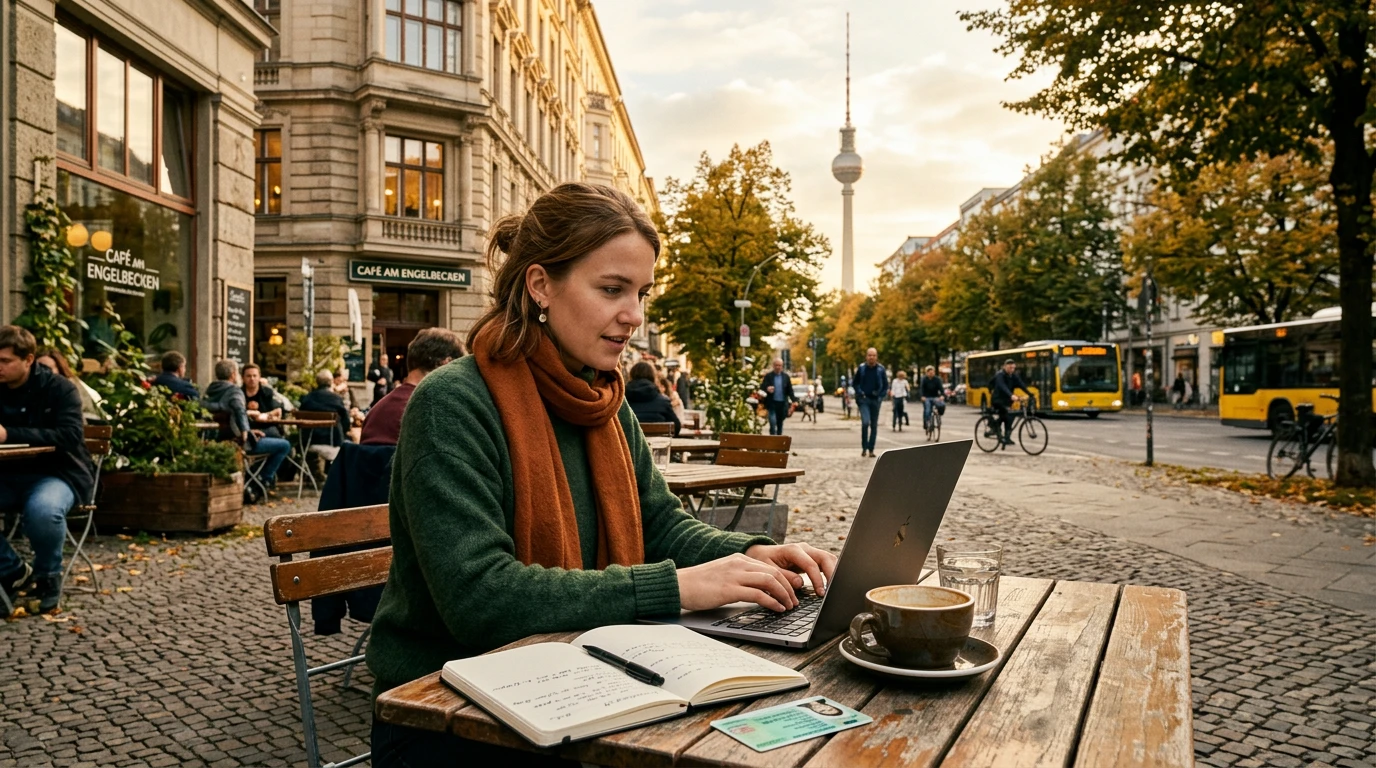
Germany does not have a visa called a “digital nomad visa.” Any article that tells you otherwise is using the term loosely. What Germany does have — and what functions in practice as its de facto path for remote freelancers — is a residence permit for freelance activity under Section 21 of the Aufenthaltsgesetz (AufenthG), commonly called the Freiberufler visa.
This guide explains exactly what it is, who qualifies, what it costs, and why it is still one of the most accessible paths into the European Union for skilled non-EU remote workers — despite the paperwork.
Not sure if Germany is the right fit for your profile? Take the free WhereToNomad quiz — it compares Germany against 49+ visa countries based on your income, passport, and lifestyle priorities.
Why Germany for Digital Nomads?
Germany has no territorial tax advantage, no NHR regime, and no fast-track nomad program. So why would a remote worker choose it?
- EU access. A German residence permit gives you free movement across the Schengen Area and preferential treatment for other EU permits. For nomads who want a European base with travel flexibility, Germany is a strong anchor.
- Path to permanent residence. After 5 years on the freelance permit (with stable income, B1 German, and no criminal record), you can apply for a Niederlassungserlaubnis — permanent residence.
- Path to EU citizenship. Germany naturalization is possible after 5 years with standard residency (or 3 years under exceptional circumstances). EU citizenship is one of the most valuable long-term assets a nomad can acquire.
- Infrastructure and banking. Germany has world-class banking, healthcare (publicly subsidized if you meet thresholds), and broadband. Berlin in particular has become Europe’s largest freelancer hub.
- Totalization agreement with the US. American nomads who pay into the German social security system may be exempt from US self-employment tax on the same income — a meaningful saving. See our US digital nomad tax guide for details.
What the Freiberufler Visa Actually Is
Under German law, a Freiberufler is a liberal professional — someone who earns income through intellectual, scientific, artistic, or teaching work. This category includes:
- Software developers and engineers
- Graphic designers and UX/UI designers
- Writers, copywriters, and translators
- Photographers and videographers
- Architects
- Consultants (management, IT, business)
- Coaches, trainers, and therapists
- Doctors, dentists, and healthcare professionals
It does not include people running a commercial trade business (selling products, hiring staff, running an agency). Those applicants must apply under the Selbständiger (self-employed entrepreneur) category, which has stricter economic-interest requirements.
The difference matters: A freelance web developer (Freiberufler) and someone running a web agency with employees (Selbständiger) face different requirements. If your work is service-based and skills-based, you are almost certainly a Freiberufler.
Who Can Apply
The Freiberufler residence permit is available to non-EU/EEA nationals. EU and EEA citizens have automatic right of residence in Germany and do not need this permit.
For non-EU nationals, including Americans, Canadians, Australians, Brits (post-Brexit), and others, the permit is available provided you meet the requirements below.
Requirements for the Germany Freelancer Visa in 2026
All information is based on Section 21 AufenthG and guidance from German immigration authorities (Ausländerbehörde).
1. Professional qualifications
Your freelance activity must fall under a recognized liberal profession. For creative and tech roles, this is usually straightforward. For regulated professions (architecture, medicine, law), you may need formal qualification recognition (Anerkennung).
2. Economic interest or cultural benefit
Under Section 21(5) AufenthG (the Freiberufler provision), your work must be of “economic interest or cultural benefit” to Germany. In practice this means:
- Having German clients (letters of intent or signed contracts)
- Demonstrating your work contributes to the German market or culture
- A business plan showing sustainable projected income
Note: Unlike the Section 21(1) Gewerbetreibender route, the Freiberufler provision does not require you to have German clients exclusively — but having at least some German connection strengthens your application significantly.
3. Financial sustainability
You must demonstrate you can support yourself. The typical income target is €30,000+ per year (approximately $32,000–$33,000 USD) for a single applicant, though individual Ausländerbehörde offices interpret this differently.
Documentation accepted:
- Signed client contracts or letters of intent showing projected income
- Bank statements showing existing savings (€10,000+ as reserve)
- Previous tax returns showing freelance income history
- A detailed income projection spreadsheet (Ertragsvorschau)
The stronger and more documented your financial case, the faster and smoother your application.
4. Health insurance
You must have comprehensive German health insurance before submitting your application. Private health insurance is required initially — look at providers like Feather Insurance (English-language, nomad-friendly, from ~€100–200/month) or Ottonova. Once established in Germany and earning below the annual threshold (€73,800 in 2025/2026), you can switch to statutory public health insurance (Gesetzliche Krankenversicherung).
For interim travel insurance before your German policy activates, VisitorsCoverage provides comprehensive international coverage.
5. Proof of accommodation
A signed rental contract (Mietvertrag) or accommodation letter is required. Berlin, Munich, Hamburg, and Frankfurt all have competitive rental markets — budget €900–1,500/month for a 1-bedroom apartment in central areas.
Book initial accommodation to scope neighborhoods before signing a long-term lease. Booking.com has a strong selection of Berlin extended-stay apartments. DiscoverCars is useful for getting around during your initial setup if you need a car: DiscoverCars Germany.
The Application Process Step by Step
Step 1: Prepare your documents
Compile the following:
- Valid passport (must have at least 6 months remaining)
- Biometric passport photos
- CV/resume highlighting your professional qualifications
- Portfolio or work samples demonstrating your freelance activity
- Business plan / income projection (Ertragsvorschau)
- Signed client contracts or letters of intent from clients
- Bank statements (last 3–6 months)
- Proof of German health insurance
- Signed rental contract or accommodation proof
- Completed application form (Antrag auf Erteilung eines Aufenthaltstitels)
If your documents are in English, you will need certified German translations (from a sworn translator — vereidigter Übersetzer).
Step 2: Enter Germany on a national visa (if required) or visa-free entry
Citizens of the US, Canada, Australia, New Zealand, UK, Japan, South Korea, and several other countries can enter Germany visa-free for up to 90 days. You can apply for the residence permit once inside Germany.
Citizens of countries that require a national visa to enter Germany must first apply for a Freelance Entry Visa at the German embassy in their home country, which allows a 3-month stay for this purpose.
Step 3: Register your address (Anmeldung)
Within 14 days of arriving at your accommodation, register at the local registration office (Einwohnermeldeamt or Bürgeramt). You will receive a registration certificate (Anmeldebestätigung) — keep this, as you need it for nearly every subsequent step.
Step 4: Book an appointment at the Ausländerbehörde
This is where the process becomes Germany-specific: getting an appointment (Termin) at the local immigration office can take 3–9 months in major cities like Berlin, according to consistent expat forum reports. Berlin’s online appointment system (service.berlin.de) releases slots at unpredictable times; use browser alert tools to notify you when new slots appear.
Munich and Hamburg have shorter wait times in general — consider these cities if timeline is a priority.
Step 5: Attend your appointment and submit documents
Bring original documents plus copies of everything. The officer will review your case, potentially ask follow-up questions about your business plan and clients, and approve or deny the application.
Approval timelines post-appointment: 4–12 weeks.
Step 6: Receive your residence permit
The permit is issued as a residence card (Aufenthaltstitel), valid for 1–3 years depending on your financial situation and business plan strength. It is renewable.
Step 7: Register as self-employed with the tax office (Finanzamt)
Once approved, register as a Freiberufler with your local Finanzamt to obtain a tax number (Steuernummer) and, if applicable, a VAT registration number (USt-IdNr.). You will need these to issue invoices.
Costs Summary
| Item | Approximate cost |
|---|---|
| Residence permit application fee | €100–150 |
| Certified translations (if needed) | €50–300 |
| German health insurance (private) | €100–200/month |
| Accommodation (Berlin 1BR, central) | €900–1,500/month |
| German language course (if needed) | €500–2,000 |
Tax in Germany
Germany taxes worldwide income for residents. If you are established as a Freiberufler in Germany, your German clients and international clients are all subject to German income tax. German income tax rates in 2026:
| Annual income | Tax rate |
|---|---|
| Up to €12,096 | 0% (basic allowance) |
| €12,096–€68,430 | 14%–42% (progressive) |
| Above €68,430 | 42% |
| Above €277,826 | 45% |
Additionally, a solidarity surcharge (Solidaritätszuschlag) of 5.5% applies to income tax amounts above certain thresholds, and church tax (Kirchensteuer, 8–9%) applies if you are a registered member of a church.
For Americans specifically: Germany has a US-Germany tax treaty and totalization agreement. The treaty prevents true double taxation, and the totalization agreement means you pay into one social security system, not both. See our US digital nomad tax guide for a detailed breakdown.
Staying Connected in Germany
Germany has excellent broadband in major cities. For mobile connectivity while you are getting set up:
- Airalo Germany eSIM — Activate before landing for immediate data access
- Yesim Germany — Alternative with competitive rates
- NordVPN — Essential for secure connections, especially at coworking spaces
Germany vs Other European Visa Options
Germany’s path is slower and more complex than several other European routes. Here is a quick comparison:
| Country | Visa type | Income requirement | Processing time | Tax burden |
|---|---|---|---|---|
| Germany | Freiberufler (Section 21) | ~€30,000/year | 3–9 months for appt | High |
| Portugal | D8 Digital Nomad Visa | ~€3,480/month | 2–3 months | Medium (NHR possible) |
| Spain | Digital Nomad Visa | ~€2,646/month | 1–3 months | Medium |
| Croatia | Digital Nomad Visa | ~€2,640/month | 2–4 weeks | Low (0% foreign income) |
| Estonia | Digital Nomad Visa | €4,500/month | 2–4 weeks | Medium |
Germany makes sense when your goals extend beyond nomadism to EU residency, German citizenship, or a permanent European base. If your goal is primarily low cost and flexibility, Portugal’s D8 visa or Croatia’s program are faster and cheaper to obtain.
Take the free WhereToNomad quiz to compare Germany against all 49+ visa countries side by side based on your profile.
Also read: Best Digital Nomad Visas in Europe | Best Cities for Digital Nomads | US Taxes for Digital Nomads | Digital Nomad Visa Income Requirements
Find your perfect digital nomad visa match
Answer 5 questions — personalized results in under 2 minutes. Free.
Take the Free Quiz →