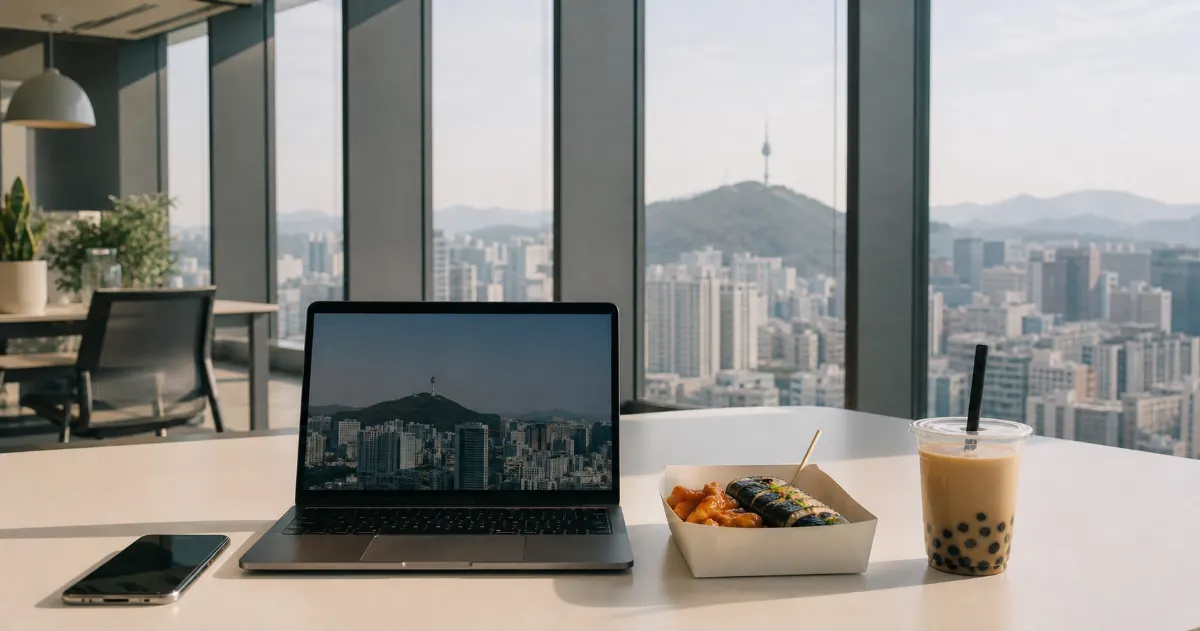
South Korea launched its Workcation (K-Workcation) visa in 2024, and Seoul has quickly become one of the most exciting cities for digital nomad Korea life. The combination of ultrafast internet (the fastest in the world), spotless infrastructure, incredible food, excellent public transit, and one of Asia’s safest major cities makes Seoul a standout for remote workers who prioritize connectivity and quality of life.
The tradeoff is cost. Seoul is more expensive than traditional nomad hubs like Chiang Mai or Bali, and the Korean language barrier is real outside tourist areas. This guide covers what works, what does not, and whether Seoul is right for your nomad style.
Take the WhereToNomad quiz to see how South Korea compares for your profile.
South Korea Workcation Visa at a Glance
| Detail | Value |
|---|---|
| Income requirement | ~$2,500/month (or proof of savings) |
| Visa fee | ~$50-80 |
| Duration | 1 year (C-4-1 visa) |
| Renewable | Limited (reapplication possible) |
| Tax on foreign income | Complex (5-year exemption possible for new residents) |
| Eligible nationalities | Varies (primarily OECD countries) |
| Processing time | 2-4 weeks |
See the full South Korea country breakdown
Why Seoul Is Special for Nomads
Internet. South Korea has the fastest average internet speed in the world. In Seoul, residential connections routinely deliver 500 Mbps to 1 Gbps. Even cafe WiFi runs at 100+ Mbps. If your work involves large file uploads, video calls in 4K, or streaming, Seoul is unmatched. A VPN may be needed for some services; see our VPN guide.
Safety. Seoul consistently ranks as one of the safest major cities in the world. Walking alone at night, leaving a laptop at a cafe table while you order, riding public transit at any hour: all perfectly normal.
Food. Korean food is extraordinary and affordable. A full meal at a local restaurant costs $5-10. Convenience stores (GS25, CU, 7-Eleven) sell surprisingly good prepared meals for $3-5. Street food markets are everywhere.
Transit. Seoul’s subway system is one of the best in the world: clean, on time, English signage, and covers the entire metro area. A T-money transit card costs ~$35/month for unlimited rides.
Cost of Living
| Expense | Monthly estimate |
|---|---|
| 1BR apartment (Gangnam/Hongdae) | $800-1,400 |
| 1BR apartment (outer areas) | $500-800 |
| Coworking | $150-300 |
| Groceries | $200-300 |
| Dining out (daily) | $200-350 |
| Transit (T-money) | $35-50 |
| Health insurance | $80-120 |
| Phone/eSIM | $20-40 |
| Total (comfortable) | $2,000-3,200 |
Seoul is mid-range for Asia, cheaper than Tokyo and Singapore, roughly on par with Bangkok’s nicer areas, and more expensive than Sri Lanka, Mexico, or other budget destinations.
Best Neighborhoods for Nomads
Hongdae. The creative/university district. Lively, affordable, excellent cafes, and a strong indie scene. Best for social nomads and nightlife.
Gangnam/Yeoksam. The business and tech hub. Startup offices, premium coworking (WeWork, FastFive), and modern apartments. Best for professional networking.
Itaewon/Hannam. The international neighborhood. English widely spoken, diverse food, and a growing creative community. Best for nomads who want English-friendly daily life.
Mapo/Mangwon. Trendy, residential, quieter than Hongdae but still walkable to it. Excellent local food markets. Best for a balanced lifestyle.
Coworking
Seoul has a thriving coworking scene. WeWork has multiple locations across the city. FastFive is a popular Korean chain with good pricing ($150-200/month). SPARKPLUS offers premium spaces in Gangnam. Many cafes also function as de facto coworking spaces; Korea’s cafe culture means spending hours working over a single Americano is perfectly acceptable.
For a list of the best options, check our best cities for digital nomads guide which covers Seoul’s coworking scene.
The Language Barrier
This is Seoul’s biggest challenge for nomads. Korean is not linguistically related to English, and while younger Koreans study English in school, daily interactions outside tourist areas (landlords, doctors, government offices, local restaurants) are primarily in Korean. Google Translate and Papago (the Korean translation app, generally more accurate for Korean) are essential.
Ordering food, navigating transit, and shopping are manageable with apps. But setting up utilities, dealing with housing contracts, or visiting a doctor without Korean ability requires either a Korean-speaking friend or a relocation agency.
Tax Considerations
South Korea’s tax system offers a potential benefit: new foreign residents can opt for a flat 19% tax rate on employment income for the first 5 years (instead of the progressive rates up to 45%). For nomads on the Workcation visa earning from foreign employers, the tax treatment depends on the specifics of your situation and residency status.
If you stay fewer than 183 days, you are generally not tax resident. Over 183 days, consult a Korean tax advisor. For US citizens, the FEIE applies as usual. See our tax guide by country for more context.
Seoul vs Tokyo vs Bangkok
| Feature | Seoul | Tokyo | Bangkok |
|---|---|---|---|
| Internet speed | 500+ Mbps | 200+ Mbps | 100-200 Mbps |
| Monthly cost | $2,000-3,200 | $2,500-4,000 | $1,200-2,200 |
| Safety | Excellent | Excellent | Good |
| English accessibility | Low-moderate | Low | Moderate |
| Nomad community | Growing | Small | Large |
| Visa ease | Moderate | Hard ($5,535/mo req) | Easy (DTV) |
Seoul wins on internet and value for money among the three. Bangkok wins on cost and community. Tokyo wins on cultural experience but is the most expensive and hardest to get a visa for.
According to Speedtest Global Index, South Korea has maintained the #1 or #2 global ranking for median fixed broadband speed since 2020.
Take the WhereToNomad quiz to see your personalized ranking.
Also read: Best Digital Nomad Visa in Asia | Best Cities for Digital Nomads | Best eSIM for Nomads | Digital Nomad Guide to Bucharest
Find your perfect digital nomad visa match
Answer 5 questions — personalized results in under 2 minutes. Free.
Take the Free Quiz →