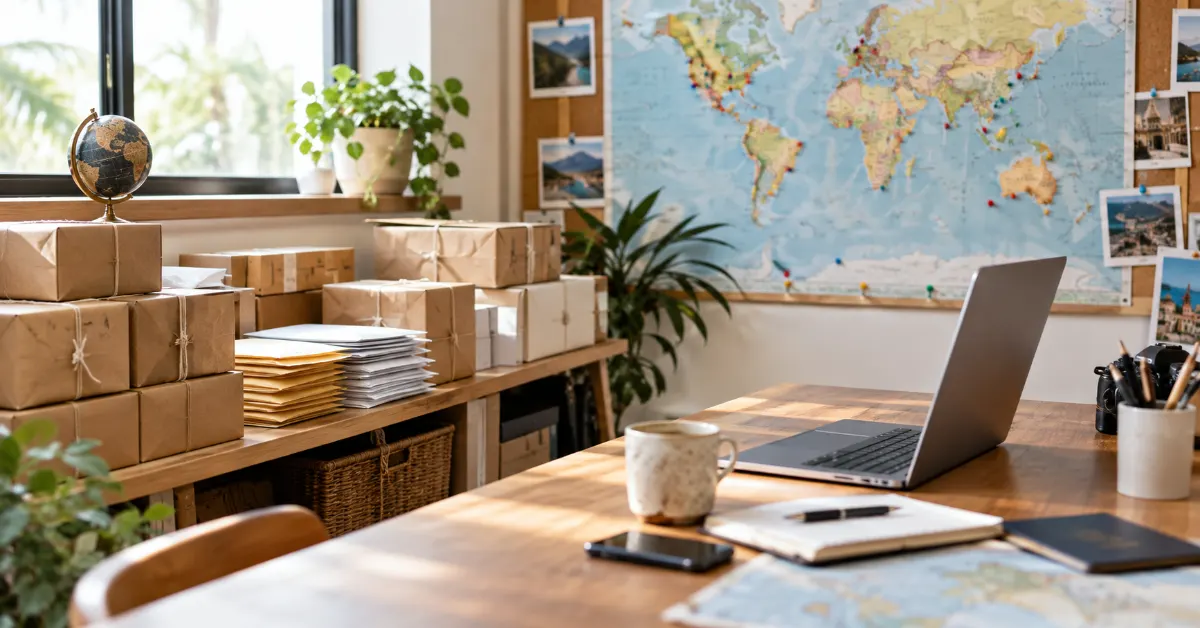
Bank statements, tax forms, replacement cards and legal notices still arrive on paper, and they all want a US street address. Good mail forwarding for digital nomads solves that by giving you a real address, scanning what arrives and shipping the important items to wherever you are. This guide compares the main services on their published plans, explains the USPS paperwork, and shows where a mailing address ends and tax domicile begins.
Last checked against official sources in October 2026.
Not sure where you will be based next year, or which mail forwarding for digital nomads setup you need? Take the free WhereToNomad quiz to find the visa and country that fit you, then set up your mail around it.
What Mail Forwarding for Digital Nomads Actually Does
A service that offers mail forwarding for digital nomads typically provides three things: a street address that receives your mail and packages, a way to see that mail online, and a way to act on it. Most services let you choose to scan the contents, shred, recycle, hold, or ship items onward. Traveling Mailbox, for example, scans every received envelope and uploads it to your account, and forwards worldwide via USPS, FedEx or UPS.
You will usually see two terms:
- Virtual mailbox: The focus is scanning and managing mail online. You rarely need the physical item.
- Mail forwarding: The focus is shipping the physical mail or packages to you. Nomads often use both.
The key trade-off is simple. Scanning is cheap and instant but gives you a picture of the letter. Forwarding gives you the original, which matters for items like a replacement debit card, but costs postage and arrives days or weeks later.
Mail Forwarding for Digital Nomads: Services Compared
This mail forwarding for digital nomads comparison uses published plans only. All figures below come from each provider’s official pages as of October 2026. Prices, tiers and locations change, so confirm on the provider site before signing up.
| Service | Published pricing | Best known for |
|---|---|---|
| Traveling Mailbox | $15, $25 or $55 per month | Simple plans, worldwide forwarding |
| iPostal1 | From $9.99 per month | Large location network |
| Anytime Mailbox | Page lists plans from $9.99 per month | Largest list of locations |
| Earth Class Mail (LegalZoom) | From $39 per month | Business-grade mail handling |
| Escapees Mail Service | $125 to $175 per year plus RV Club membership | Domicile in TX, FL or SD |
| St. Brendan’s Isle | $100 initial card deposit | Florida domicile for cruisers |
Traveling Mailbox
For simple mail forwarding for digital nomads, Traveling Mailbox lists three monthly plans. Basic is $15 for 40 incoming envelopes and 35 page scans. Extended is $25 for 100 envelopes and 80 page scans. Small Business is $55 for 200 envelopes and 180 page scans. Every received envelope is scanned without a per-request charge, and the first 30 days of package storage are free. Forwarding costs postage plus $2 per shipment, and you can consolidate items into one shipment. Residency in any state is not required, and the service is based in Sanford, North Carolina. Visit Traveling Mailbox →
iPostal1
For mail forwarding for digital nomads who want choice of location, iPostal1 advertises over 4,250 mailbox locations and three plans: Virtual Mailing Address from $9.99 per month, Virtual Business Address from $14.99 and Virtual Office from $39.99. Price depends on the location tier you pick. Features include forwarding, scanning, check deposit at some locations and unlimited cloud storage. For US locations it states that Form 1583 must be notarized and filed with two forms of ID, and it offers an online notary service for $25. Visit iPostal1 →
Anytime Mailbox
Anytime Mailbox is a mail forwarding for digital nomads option built as a marketplace of independent operators. Its site lists about 2,500 locations, with the most in California, Texas and Florida. Plans on its site start at $9.99 per month, and one comparison page lists forwarding at $5 per shipping bundle, 30 incoming pieces per month and a first scan allowance of 5 pages. Because each location sets some of its own fees, compare the specific location you plan to use. Visit Anytime Mailbox →
Earth Class Mail
Earth Class Mail is now part of LegalZoom, and its old pricing page redirects to LegalZoom’s Virtual Mail page. Plans there start with Starter MailBox at $39 per month for one address, two recipients and five digitized items. Higher tiers go up to $299 per month. That makes it a business tool more than a nomad budget option, so most solo nomads will look elsewhere. Visit LegalZoom Virtual Mail →
Domicile services for mail forwarding for digital nomads
Escapees and St. Brendan’s Isle are built for people who travel full time and want a legal home state.
Escapees requires membership in the Escapees RV Club. Its mail service lists annual fees of $125, $145 and $175 depending on category, optional scanning at $10 per month, and package forwarding at $1 each. Its page says you can use a Texas, Florida or South Dakota address for driver licensing, vehicle titles and voter registration, and notes the Florida and South Dakota locations are sub-stations with sign-ups handled through Texas. Its FAQ gives a slightly different fee range, so confirm the current fee when you enroll. Visit Escapees →
St. Brendan’s Isle serves cruisers and travelers who want a Florida address. A cruiser guide describes a $100 credit card deposit, a Green Cove Springs address, and a Declaration of Domicile that costs $15 per person to file in Clay County. Treat that as a third-party description and check the provider’s own pages for the current process.
USPS Form 1583 and Mail Forwarding for Digital Nomads
Any service that gives you a street address and receives mail on your behalf is a commercial mail receiving agency (CMRA). The USPS Domestic Mail Manual, section 508, sets the rules.
- Form 1583: Each addressee completes one. A separate form is needed for each private mailbox used for personal purposes, and spouses each complete their own.
- ID: You present acceptable primary and secondary forms of ID, and they must be current.
- Signature: You sign in front of the CMRA staff or have your signature acknowledged by a commissioned notary. USPS says physical or real-time audio and video presence is accepted.
- Address format: Mail should use “PMB” or ”#” with your box number, and mail without it can be returned as undeliverable.
- Records: The CMRA uploads your ID copies to a USPS database and must certify its forms every quarter.
- If you leave: The CMRA must remail your mail for at least six months, with new postage.
On the paperwork side of mail forwarding for digital nomads, Escapees states plainly that its Form 1583 “must be notarized,” and you can use an online or in-person notary. For nomads abroad, online notarization is the practical route. iPostal1 sells one for $25, and the cruiser guide for St. Brendan’s Isle says remote online notarization is available. Do this early, so your setup for mail forwarding for digital nomads is complete before your first important letter arrives.
Scanning vs Forwarding in Mail Forwarding for Digital Nomads
In mail forwarding for digital nomads, use scanning for anything you only need to read: statements, tax notices, jury summonses, insurance letters. Use forwarding for items you must physically hold: new bank cards, official certificates, a passport renewal packet and parcels. A smart setup for mail forwarding for digital nomads:
- Scan everything by default.
- Hold physical items for a set period, because Traveling Mailbox holds envelopes free for 30 days and then shreds unheld mail.
- Batch forwarding. Traveling Mailbox charges $2 per shipment rather than per item, and Anytime Mailbox lists $5 per bundle, so consolidating saves money.
- Aim your forwarding at a stable address, such as a short-term rental or a coworking space, and ship only when you are sure to be there.
Parcels need extra care in any mail forwarding for digital nomads setup. Escapees says packages cannot be forwarded internationally, while Traveling Mailbox says it can forward packages worldwide, so check the rule for your service and destination.
Domicile Address Services in South Dakota, Texas and Florida
A mailing address is not the same thing as a legal home, even with the best mail forwarding for digital nomads. Domicile is where you intend to make your permanent home, and tax authorities look at your actual ties. A California tax attorney’s guide says it is the strength of your ties, not just the number, that decides residency, and lists driver license, family location, principal residence and bank accounts among the factors.
For mail forwarding for digital nomads who want a tax-light home state, many full-time travelers choose South Dakota, Texas or Florida because they have no state income tax. Escapees describes the three states as having no state income tax and notes that South Dakota does not require you to return each year to register vehicles, while Texas and Florida expect more regular returns.
South Dakota’s licensing department sets real conditions. For a full-time traveler using a forwarding service, it requires a notarized residency affidavit, and renewal by mail needs a receipt for one night in a South Dakota hotel, motel, campground or RV park within the last year, plus a document proving your personal mailbox address. The department states that virtual addresses are not accepted. Texas asks for two printed proofs of residency, with one showing at least 30 days of Texas residence, or a residency affidavit if you cannot supply them.
Before you use mail forwarding for digital nomads as part of a domicile change, read our state taxes for digital nomads guide before changing domicile. A forwarding address helps your paperwork, but it does not by itself change where your state tax liability lies, and a state that believes you never left can still claim you. Our digital nomad taxes for Americans guide covers the federal side. For complex moves, hire a tax professional.
Which Addresses Banks Accept for Mail Forwarding for Digital Nomads
Anyone using mail forwarding for digital nomads should know that banks must verify a real street address when you open an account, and many automatically flag CMRA addresses. A business-focused guide says banks generally will not accept a virtual mailbox as your physical or residential address, and that the usual workaround is to use a verifiable physical address in the residential field and the virtual mailbox as the mailing field. Acceptance varies by bank, so ask before you apply.
Practical rules:
- Keep your ID, application and supporting documents on the same address.
- Do not use a PO box or registered agent address as your main address.
- Use the virtual address for statements only after the account is open and verified.
See best bank accounts for digital nomads and our Wise vs Revolut vs Payoneer vs Schwab comparison for account options that are friendly to people abroad.
How to Choose Mail Forwarding for Digital Nomads
- Light mail, no domicile need: A low-cost virtual mailbox with scanning is enough.
- Heavy mail or a business: Pick a plan with large scan allowances or a business-grade provider.
- Wanting a legal home state: Choose a domicile service and satisfy the state’s actual requirements.
- Frequent packages: Check storage fees and international shipping rules first.
- Visa applications: Use your real address abroad for immigration paperwork, and keep the US address for your US accounts.
The best mail forwarding for digital nomads is the plan that matches how much paper you really receive. Most people overpay for allowances they never use.
Frequently Asked Questions
What is mail forwarding for digital nomads?
Mail forwarding for digital nomads is a service that gives you a street address, receives your mail and packages, and then scans, holds or ships them to wherever you are. Many services combine a virtual mailbox with forwarding.
Do I need to notarize USPS Form 1583 for mail forwarding for digital nomads?
Yes, unless you sign it in the presence of the mailbox staff. USPS rules allow a notary acknowledgment, and physical or real-time audio and video presence is accepted.
Can I use a virtual mailbox address for my bank?
Usually only as a mailing address. Banks generally want a verifiable physical address, and many flag commercial mail receiving agency addresses.
Does a South Dakota, Texas or Florida mail address make me a resident for tax purposes?
Not by itself. Domicile depends on real ties and intent, and states can challenge it if you never lived there.
How much does mail forwarding for digital nomads cost?
Published plans on provider sites range from about $9.99 per month for basic virtual mailboxes to $39 per month or more for business-grade services, plus postage for forwarding. Domicile services such as Escapees list annual fees of $125 to $175.
Also read: State Taxes for Digital Nomads | Digital Nomad Taxes for Americans | Best Bank Accounts for Digital Nomads | Digital Nomad Tax Free Countries
Find your perfect digital nomad visa match
Answer 5 questions — personalized results in under 2 minutes. Free.
Take the Free Quiz →