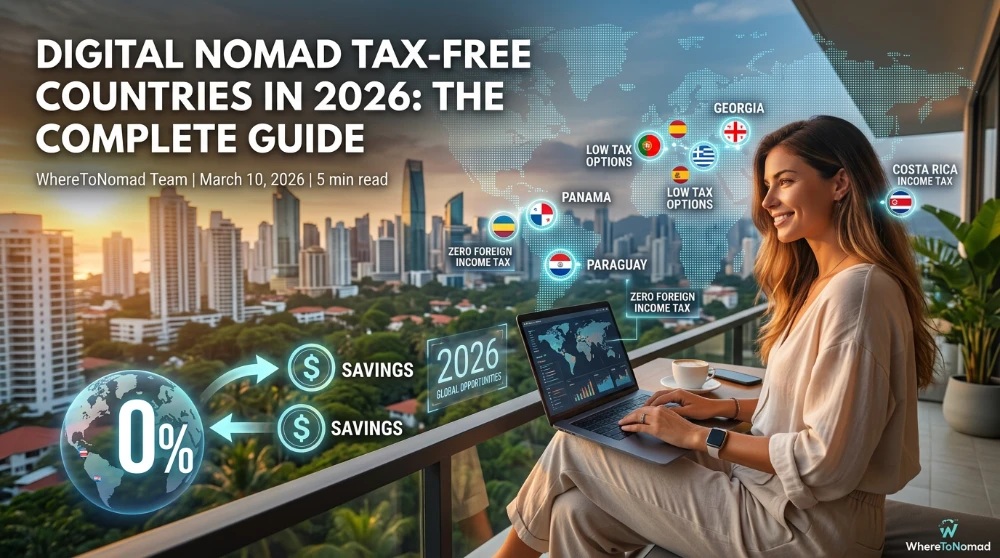
Tax is the single biggest financial lever available to digital nomads — and the most misunderstood. Many nomads move abroad expecting to pay zero tax, only to discover their new country taxes them on worldwide income, or their home country does, or both. This guide breaks down exactly which digital nomad tax-free countries exist in 2026, how the exemptions work, and the traps that catch nomads off guard every year.
Not sure which tax-free country fits your profile? Take the free WhereToNomad quiz and get personalized results with tax status on every result card.
What “Tax-Free” Actually Means for Digital Nomads
When we say a country is “tax-free” for digital nomads, we mean one specific thing: the country does not tax income you earn from foreign sources. This is called a territorial tax system. You pay tax only on income generated within that country’s borders — which, for a remote worker paid by foreign clients or a foreign employer, means your effective local tax rate is zero.
This is completely separate from your home country’s tax obligations. US citizens, for example, are taxed on worldwide income by the IRS regardless of where they live. The OECD Model Tax Convention provides a framework for how countries handle cross-border taxation, but each country implements its own rules.
Fully Territorial Tax Systems (Zero Tax on Foreign Income)
These countries apply zero income tax to earnings sourced outside their borders:
Georgia
Georgia’s territorial tax system is one of the most permissive in the world. Foreign-sourced income — including freelance income, salary from foreign employers, and investment income from abroad — is completely exempt from Georgian income tax. Combined with the free Remotely from Georgia visa and a cost of living under $1,800/month, Georgia is consistently ranked as one of the best digital nomad tax-free countries overall.
See the full Georgia breakdown →
Panama
Panama’s territorial system has been in place for decades and is well-tested. Income from foreign sources is never taxed locally, regardless of residency status. Panama’s Short Stay Remote Worker Visa specifically targets digital nomads and requires $3,000/month in verified income. The country’s banking system, US dollar economy, and proximity to the US make it especially attractive for American nomads.
See the full Panama breakdown →
Paraguay
Paraguay is one of the most overlooked digital nomad tax-free countries. Foreign income faces zero local tax, the residency process is relatively straightforward, and Asuncion offers a very affordable cost of living. Paraguay does not have a dedicated digital nomad visa but issues residency to remote workers through a general temporary residency pathway.
Costa Rica
Costa Rica’s tax system taxes only income generated within Costa Rica. A remote worker paid by US or European clients owes zero local income tax. Combined with the formal Digital Nomad Visa (launched 2022), Costa Rica is one of the most complete packages: legal visa, tax-free foreign income, and a well-established expat infrastructure.
See the full Costa Rica breakdown →
Partial Tax Regimes (Reduced, But Not Zero)
Some countries offer digital nomads significant tax discounts without going fully territorial:
Portugal — NHR Regime
Portugal’s Non-Habitual Resident (NHR) regime grants new residents a 10% flat rate on foreign pension income and reduced rates on other foreign income for a 10-year period. It’s not fully tax-free, but for high earners the saving versus home-country rates can be enormous. Portugal also offers a clear path to EU residency.
See the full Portugal breakdown →
Spain — Beckham Law
Spain’s “Beckham Law” (officially the Special Expatriates Tax Regime) caps income tax at 24% for earnings up to €600,000 for up to six years. For Americans used to paying 32–37% federal income tax plus state tax, this is a substantial saving — especially in a high-quality-of-life country.
See the full Spain breakdown →
Greece — Digital Nomad Flat Tax
Greece offers a 7% flat tax rate for foreign pension income under its retiree regime, and has various incentives for digital nomads who transfer their tax residency. The digital nomad visa itself allows stays of up to 12 months renewable.
See the full Greece breakdown →
The Tax Trap Countries to Avoid
Not every country that markets itself as digital-nomad-friendly is tax-efficient. Watch out for:
The 183-Day Rule: In virtually every country in the world, spending more than 183 days per calendar year triggers tax residency — even if your visa does not impose local taxes. This catches a lot of nomads who think their “zero-tax” visa exempts them.
Germany, France, Italy (High Tax + Aggressive Residency Rules): These countries have among the most aggressive tax residency trigger mechanisms in Europe. Even short stays can create tax exposure if you maintain a “habitual abode” or “center of vital interests” there.
Thailand (New Rules from 2024): Thailand recently changed its rules to tax foreign income remitted into Thailand in the same tax year it was earned. Nomads on Thailand’s LTR visa are exempt, but those on tourist visas or standard stays are not.
US Citizens: The FEIE Strategy
For American digital nomads, the most powerful tax tool is the Foreign Earned Income Exclusion (FEIE). If you live abroad and meet either the Bona Fide Residence Test or the Physical Presence Test (330 days outside the US in a 12-month period), you can exclude up to $126,500 (2024 figure, indexed annually) of foreign-earned income from US federal income tax.
Stack this with a territorial-tax country like Panama or Georgia, and an American earning $100,000/year could legally pay close to zero income tax total — at both the local and federal level.
You can file your US return from anywhere using e-file.com, which supports FEIE and Foreign Tax Credit forms. Always work with a qualified US expat tax advisor before relocating. The rules are complex and the penalties for getting them wrong are severe.
How to Find Your Best Tax-Free Match
Use the WhereToNomad quiz to enter your income, nationality, and tax priorities. Every result card shows the tax status (Tax Free / Low Tax / Full Tax) plus any known tax trap warnings — so you never get caught out.
Also read: US Digital Nomad Taxes: FEIE, FTC, and the Best Countries | Best Bank Accounts for Digital Nomads | DN Visa vs Tourist Visa | Income Requirements Ranked | Best in Europe | For Americans | How to Apply
Find your perfect digital nomad visa match
Answer 5 questions — personalized results in under 2 minutes. Free.
Take the Free Quiz →