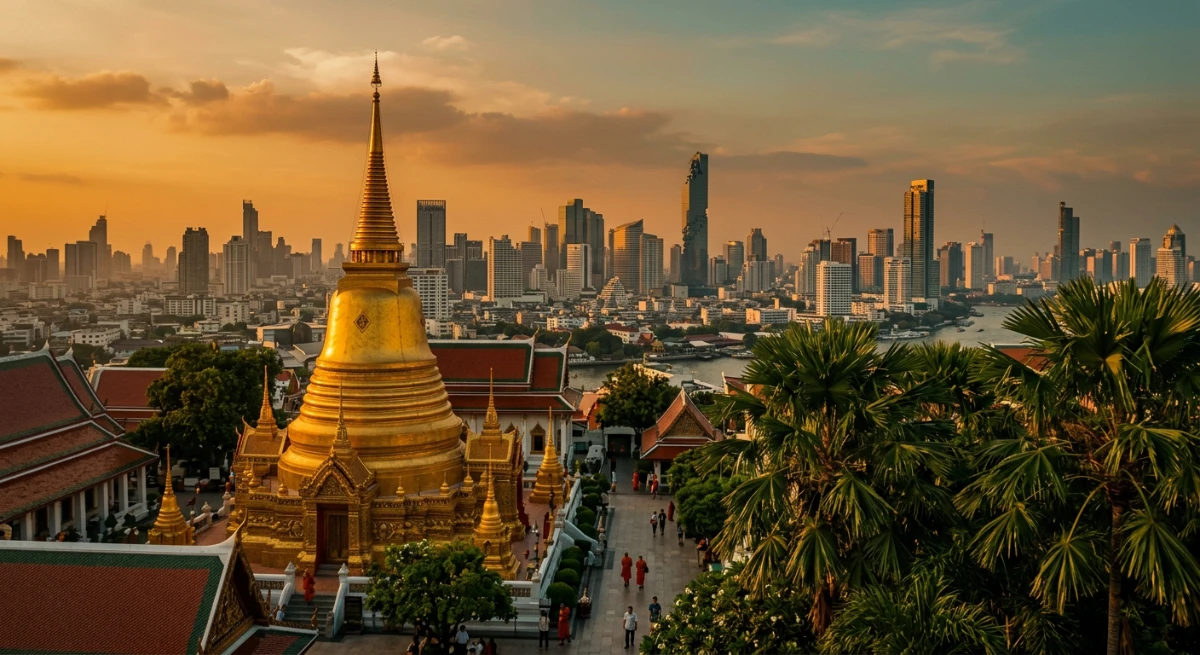
The Thailand Destination Thailand Visa (DTV), launched in July 2024, has rapidly become the single most-discussed digital nomad visa in the world. The combination of 5-year duration, flexible 180-day stays per entry, low financial bar (THB 500,000 in liquid assets), and Thailand’s existing infrastructure makes the DTV one of the strongest digital nomad programs ever launched anywhere.
This guide covers everything you need to know about the Thailand DTV visa in 2026: who qualifies, what it costs, how to apply, what the tax implications are, and how to set up your life in Bangkok or Chiang Mai once approved. Want to compare against alternatives? Take the free WhereToNomad quiz for personalized matches.
What Is the Thailand DTV Visa?
The Destination Thailand Visa is a multiple-entry, long-stay visa launched by the Thai Ministry of Foreign Affairs in July 2024. It targets four explicit categories:
- Workcation applicants: Remote workers and freelancers earning income from foreign sources
- Soft Power activity participants: Muay Thai students, Thai cooking class enrollees, traditional medicine students, sports training participants
- Medical treatment applicants: Long-term medical tourists
- Dependents: Spouses and children under 20 of primary applicants
For digital nomads, the workcation category is the relevant pathway. The DTV grants:
- 5-year visa validity from issuance
- 180 days per entry with the ability to leave and re-enter to reset the clock
- Multi-entry: Unlimited entries during the 5-year validity
- One 180-day extension permitted per entry at Thai immigration (THB 10,000 fee)
In practice, each entry gives you 180 days. You can extend that entry once for another 180 days at Thai immigration (THB 10,000), giving you up to 360 consecutive days in Thailand per entry. Once that 360-day window ends, you must leave Thailand and re-enter to start a new 180-day entry. This pattern can repeat throughout the full 5-year validity period.
Who Qualifies for the Thailand DTV Visa?
The DTV has three core eligibility requirements:
1. Age: You must be 20 or older.
2. Financial means: You must demonstrate THB 500,000 (approximately $15,000 USD) in liquid assets in your own name. This is shown via:
- Bank statement balance of THB 500,000+ for the prior 3-6 months (depending on embassy)
- Proof of stable monthly income equivalent
Sponsorship letters are tightly restricted. Funds in another person’s account generally do not count unless that person is your legal spouse, or unless you are applying as a dependent child of a primary DTV applicant. Friends, partners (unmarried), parents (for adult applicants), and employers cannot sponsor your financial requirement. The funds must be yours.
Note: Cryptocurrency holdings and investment portfolios are typically not accepted; funds should be in liquid bank accounts.
3. Activity-based qualification: For the workcation category, you must show one of:
- Employment contract with a foreign company
- Freelance agreements with foreign clients
- Portfolio of remote work demonstrating ongoing income
- Proof of digital business ownership
Notably, the DTV does NOT require:
- A formal monthly income threshold
- Local Thai sponsorship
- Educational qualifications
- A specific profession beyond “remote-capable”
This makes it one of the most accessible digital nomad visas globally for workers who can demonstrate ongoing remote income but earn under the formal thresholds of programs like Portugal D8 ($3,680/mo) or Spain ($2,900/mo).
See the full Thailand country breakdown →
Thailand DTV Cost Breakdown
The headline visa fee is THB 10,000 (approximately $300 USD), but the realistic full cost of obtaining a DTV is higher. Here’s what to budget:
| Item | Cost (USD) |
|---|---|
| DTV visa fee | ~$300 |
| Document apostille and translation | $100-300 |
| Health insurance (annual, recommended) | $600-1,800 |
| Tax/legal consultation (recommended) | $200-500 |
| 180-day extension fee (per use) | ~$300 |
| Total first-year cost | $1,500-3,200 |
This is dramatically cheaper than the European alternatives ($1,500-2,000+ for Portugal D8, $1,200-2,000+ for Spain) and on par with the cheapest Asian options.
How to Apply for the Thailand DTV Visa: Step by Step
The DTV application process is fully online via the Thai e-Visa portal. The standard timeline is 2-6 weeks from submission to issuance.
Step 1: Gather Required Documents
For the workcation category, you’ll need:
- Valid passport with at least 6 months remaining validity
- Recent passport-size photos (white background)
- Bank statement showing THB 500,000+ for the prior 3-6 months
- Proof of remote work: employment contract, freelance contracts, business ownership documents, or portfolio
- Proof of accommodation in Thailand (hotel booking for first month is typically sufficient)
- Health insurance (see Insurance section below; not federally mandated but some embassies require it)
- Round-trip or onward travel itinerary
For document preparation, see our universal application step-by-step guide which covers apostille requirements, translation needs, and common rejection reasons.
Step 2: Submit Online via Thai e-Visa Portal
Apply through the official e-Visa portal (thaievisa.go.th) of the Royal Thai Embassy or Consulate that covers your country of residence. Since early 2025, all Thai visa applications must be processed online; embassies no longer accept walk-in physical applications. The core process is:
- Create an account on the e-Visa portal
- Select “Destination Thailand Visa (DTV)” and your activity category (Workcation)
- Upload all required documents
- Pay the visa fee (~$300) via credit card
- Submit and await processing
You must apply from outside Thailand and be physically present in the country whose embassy you are applying through.
Step 3: Wait for Processing
Processing times vary by consulate but generally run 2-6 weeks. Some applicants report faster turnaround (under 2 weeks) at consulates with lower volume; expect longer at high-volume consulates serving the US, UK, and Australia.
You will receive an email with your DTV stamped into your e-Visa record. Print this confirmation; you will need it at Thai immigration on entry.
Step 4: First Entry and 180-Day Stamp
On first entry to Thailand, present your passport and DTV approval at immigration. You will receive a 180-day entry stamp. From this date, you have 180 days legal stay before you must either:
- Apply for a 180-day extension at Thai immigration (THB 10,000)
- Exit Thailand and re-enter to reset the 180-day clock
Step 5: 90-Day Reporting (After 90 Days)
If you stay continuously for more than 90 days in Thailand, you must complete TM47 90-day reporting at any Thai immigration office (or online via the immigration website if eligible). This is administrative only (no fee), but missing it triggers fines starting at THB 2,000.
Step 6: 180-Day Extension (Optional)
To extend a 180-day entry by another 180 days, apply at any Thai immigration office at least 30 days before your original 180-day permit expires. Bring your passport, original DTV approval, and THB 10,000 cash. The extension is single-use per entry: after 360 days total, you must leave Thailand and re-enter to start a new 180-day stay.
Where to Live on a Thailand DTV: City Guide
The DTV does not restrict where in Thailand you live. The four main digital nomad cities each cater to different lifestyles.
Bangkok: The Tier-1 Infrastructure Pick
Bangkok delivers world-class urban infrastructure at half to one-third the cost of comparable Western cities. BTS and MRT public transit, fiber internet at 300+ Mbps in any modern apartment, JCI-accredited hospitals (Bumrungrad and Bangkok Hospital), and a food scene that runs the gamut from $3 street meals to $300 omakase.
Best nomad neighborhoods:
- Asok / Sukhumvit Soi 21: Central, transit-connected, restaurant-dense
- Thong Lor / Ekkamai: Upscale residential with walkable cafes
- Ari: Hipster neighborhood, weekend coffee culture
- Phra Khanong: Budget-conscious with newer condos
Browse Bangkok accommodation on Booking.com for short-term flexibility, or Agoda Thailand which has the strongest Thailand inventory of any platform. Most nomads transition to monthly leases via local agents after the first month.
Monthly cost: $1,800-2,800 for comfortable single-person living.
Chiang Mai: The Original Nomad Capital
Chiang Mai built modern digital nomad culture. Long before Bali had cafes with WiFi or Lisbon launched a visa, Chiang Mai’s Nimman district was where remote workers gathered. The community remains the most welcoming in Asia for new nomads.
Best nomad neighborhoods:
- Nimmanhaemin (Nimman): Cafe-dense, coworking-rich, the original nomad zone
- Old City: Ancient walls, temples, slower pace
- Santitham: Local feel, lower cost
- Hang Dong: Quiet suburban, valley views
Cost: $1,200-1,800/month for comfortable living. Burning season (February-April) brings poor air quality; many nomads leave for those months.
Phuket: The Beach-Plus-Infrastructure Pick
Phuket has matured significantly as a digital nomad destination since 2020. Patong is touristy and skippable, but Rawai, Kata, and Bang Tao deliver beach-front living with serviceable infrastructure. International schools make Phuket popular with nomad families.
Cost: $2,000-3,000/month.
Find Phuket accommodation on Agoda or Booking.
Koh Samui: The Lower-Density Beach Option
Koh Samui delivers a quieter beach-island lifestyle than Phuket with more authentic Thai culture intact. Bo Phut, Maenam, and Lamai are the established expat areas. Internet has improved significantly with island-wide fiber rollout.
Cost: $1,800-2,500/month.
For full Thailand city analysis with comparable global cities, see our best cities for digital nomads guide.
Thailand DTV Tax: The Critical 2024 Rule Change
Thai tax rules changed significantly in January 2024. Previously, foreign income was tax-free in Thailand if not remitted in the same year it was earned. The new rule taxes foreign income remitted into Thailand in the same calendar year it was earned, with assessment based on whether you are a Thai tax resident.
Key implications for DTV holders:
1. Thai tax residency. You become a Thai tax resident if you stay in Thailand for 180+ days in a calendar year. DTV holders staying for full 180-day stretches will likely cross this threshold.
2. Foreign income remittance. Foreign income remitted to Thailand in the same year you earned it is taxable for tax residents at progressive rates (5-35%).
3. Practical workaround. Many DTV holders maintain foreign bank accounts and only remit money to Thai accounts that was earned in a prior tax year, which preserves tax-free status under the existing rules.
4. LTR visa holders are exempt. The Long-Term Resident (LTR) visa, which has different requirements, retains the prior year-of-remittance exemption. DTV holders do not get this carve-out.
For American DTV holders, the Foreign Earned Income Exclusion (FEIE) still applies independent of Thai tax: you can exclude up to $132,900 (tax year 2026) from US federal tax if you meet the bona fide residence or 330-day physical presence tests. Combined with prudent remittance planning, an American DTV holder earning $100,000/year can legally minimize tax to a low effective rate.
You can file your US return from Thailand using e-file.com. For Thai tax specifically, work with a qualified Thai tax advisor before assuming any particular remittance strategy will work for your situation. Thai tax law is evolving rapidly.
For the broader tax-free countries comparison, Thailand under the post-2024 rules is no longer fully tax-free for nomads who remit income in the year earned.
Insurance Requirements for the DTV
Health insurance is not mandated at the federal level for the DTV. However, individual Thai embassies and consulates have discretion to require proof of insurance as part of their local documentation requirements, and some require minimum coverage of approximately USD $50,000. Always check with the specific embassy you’ll be applying through.
Even when not required for the application itself, comprehensive medical insurance is strongly recommended. A serious medical event in Thailand at a private hospital can run $30,000-50,000+ before stabilization, and Thailand has one of the highest road accident rates in the world.
For DTV applicants, a global plan via VisitorsCoverage typically meets visa documentation requirements when an embassy requires proof. Other widely-used options in the digital nomad space include SafetyWing Nomad Insurance, Genki Traveler, and Cigna Global for higher-end international coverage.
See our full insurance comparison guide for detailed plan comparisons.
Setup Essentials: Your First 7 Days in Thailand
The standard nomad setup checklist for a DTV holder arriving in Thailand:
Day 1: Connectivity
Before you even leave the airport, get connected. Thailand eSIM via Airalo installs in minutes via QR code and connects you to AIS or DTAC. Local plans on Airalo cost roughly $5 for 1GB, $20 for 10GB, $40 for unlimited 30 days. For multi-country nomads, consider Yesim’s Thailand plan for pay-as-you-go flexibility.
If you plan a longer stay (6+ months), consider getting a physical AIS or TrueMove SIM with a 12-month plan once you have your visa-stamped passport. Local plans run $15-25/month for 30GB+ data.
For full coverage of mobile data choices, see our best eSIM comparison.
Day 1-2: Accommodation Strategy
Most DTV holders book a 1-month stay at a serviced apartment via Booking.com Bangkok or Agoda Thailand. Agoda has the deepest Thailand inventory and is owned by the same parent as Booking but typically shows lower rates for Thai properties.
After the first month, transition to a 6-12 month lease via local property agents. Bangkok agents (try DDproperty, Hipflat, or Bangkok-based Facebook groups) typically charge no fee to tenants since landlords pay the commission.
Day 2: VPN Setup
Thailand officially restricts certain content and a meaningful percentage of US/UK streaming services geo-block Thai IPs. A reliable VPN is non-negotiable for working effectively from Thailand.
NordVPN is the standard nomad pick: 6,300+ servers, fast NordLynx protocol (built on WireGuard), works reliably with Netflix, banking apps, and home country services. From $3.59/month on a 2-year plan. See our best VPN comparison for alternatives.
Day 2-3: Banking
Opening a Thai bank account on a DTV is now possible at most major Thai banks (Bangkok Bank, Kasikorn, SCB) with your DTV-stamped passport, work proof, and proof of address. Bring lease, employer letter or contracts, and Thai phone number.
Until your Thai account is set up, multi-currency fintech accounts handle nearly all banking needs, letting you hold THB at the real exchange rate and use a debit card at any Thai ATM (you’ll pay your home bank’s foreign withdrawal fee plus the Thai bank’s ATM fee, typically THB 220).
Day 3-7: Coworking, Healthcare, and Community
Coworking: Bangkok has dozens of dedicated coworking spaces. The most popular for nomads: WeWork Asok, JustCo, The Hive, and StartupGlass. Day passes run $10-20; monthly passes $150-300.
Healthcare: Register at a private hospital like Bumrungrad (Sukhumvit Soi 3) or Bangkok Hospital (Phetchaburi) so you have a relationship in place before any need arises. Initial consultation typically runs THB 1,500-3,000.
Community: Bangkok has the largest digital nomad community in Southeast Asia. Major recurring events: Bangkok Digital Nomad meetups (Meetup.com), Sunday brunch crowd at Roast or Roots Coffee, and various coworking-hosted events.
For the broader nomad toolkit, see our digital nomad toolkit guide.
Thailand DTV vs Other Asian Nomad Options
How does the Thailand DTV stack up against other Asian digital nomad visas?
| Factor | Thailand DTV | Indonesia E33G | Malaysia DE Rantau |
|---|---|---|---|
| Income/asset bar | ~$15,000 savings | $60k/yr income | $24k/yr income |
| Duration | 5 years (180 days/entry) | 1 year, non-extendable | 12 months renewable |
| Tax on foreign income | Conditional (post-2024 rules) | Full if tax-resident | None (territorial) |
| Cost of living | $1,500-2,800 | $1,500-2,500 | $1,800-2,500 |
| Internet | 300+ Mbps | 50-200 Mbps | 200+ Mbps |
For most nomads earning $2,000-4,000/month, the Thailand DTV is the strongest single option in Asia thanks to the 5-year validity and low financial bar. For tax-conscious nomads, Malaysia’s territorial system may offer cleaner long-term tax efficiency.
Common DTV Application Mistakes
1. Insufficient documentation of remote work. The most common rejection reason. Provide more evidence than the minimum: contracts, bank statements showing income, portfolio links, employer letters. Stack multiple proof types.
2. Bank statement under THB 500,000 too recently. Your bank must show THB 500,000 (~$15,000) consistently for at least 3-6 months prior to application. Topping up shortly before applying is flagged.
3. Insurance coverage too low when an embassy requires it. While not federally mandated, embassies that ask for insurance often look for at least USD $50,000 in coverage given typical Thai medical costs. Confirm requirements with your specific embassy.
4. Missing apostilles on US-issued documents. US criminal background checks and other official documents typically require apostille. This adds 2-4 weeks to processing.
5. Ignoring the 90-day reporting requirement. Once in Thailand, file TM47 90-day reports at any immigration office. Skipping this triggers fines.
6. Cryptocurrency or investment portfolios as proof of funds. Thai consulates generally only accept liquid bank balances. Move funds to a regular bank account 3-6 months before applying.
For the full universal mistakes list, see our how to apply guide.
Compare Thailand DTV to Global Alternatives
If you’re weighing Thailand against other nomad destinations, our regional guides cover comparisons:
- Best Digital Nomad Visa in Asia for Bali, Malaysia, Japan, South Korea
- Best Digital Nomad Visa in Europe for Portugal, Spain, Croatia
- Best Digital Nomad Visa in Latin America for Mexico, Colombia, Costa Rica
- Best Caribbean Digital Nomad Visas for Barbados, Antigua, Cayman
- Income Requirements: Every Country Ranked to filter by what you actually earn
- Cheapest Digital Nomad Visas for budget-focused options
Find Your Best Match
The Thailand DTV is one of the strongest digital nomad visas globally, but the right choice depends on your income, passport, family situation, and tax priorities. Take the free WhereToNomad quiz to see your personalized ranked list of every visa you qualify for.
Also read: Best Digital Nomad Visa in Asia | Best Cities for Digital Nomads | How to Become a Digital Nomad | How to Apply for a Digital Nomad Visa | Best Travel Insurance | Best eSIM for Nomads | Best VPN for Nomads | Tax-Free Countries
Find your perfect digital nomad visa match
Answer 5 questions — personalized results in under 2 minutes. Free.
Take the Free Quiz →